
Fire Strategy Review & Validation
Independent review and validation of fire strategies for regulated and higher-risk buildings.
Risk Warden provides Fire Strategy Review & Validation services for organisations requiring independent scrutiny of fire safety design intent, performance assumptions and regulatory alignment. In Higher-Risk Buildings and complex developments, independent validation strengthens regulatory defensibility and governance confidence.
What is Fire Strategy Review & Validation?
A Fire Strategy sets out the fire safety principles and design assumptions that underpin a building’s construction, layout and ongoing operation.
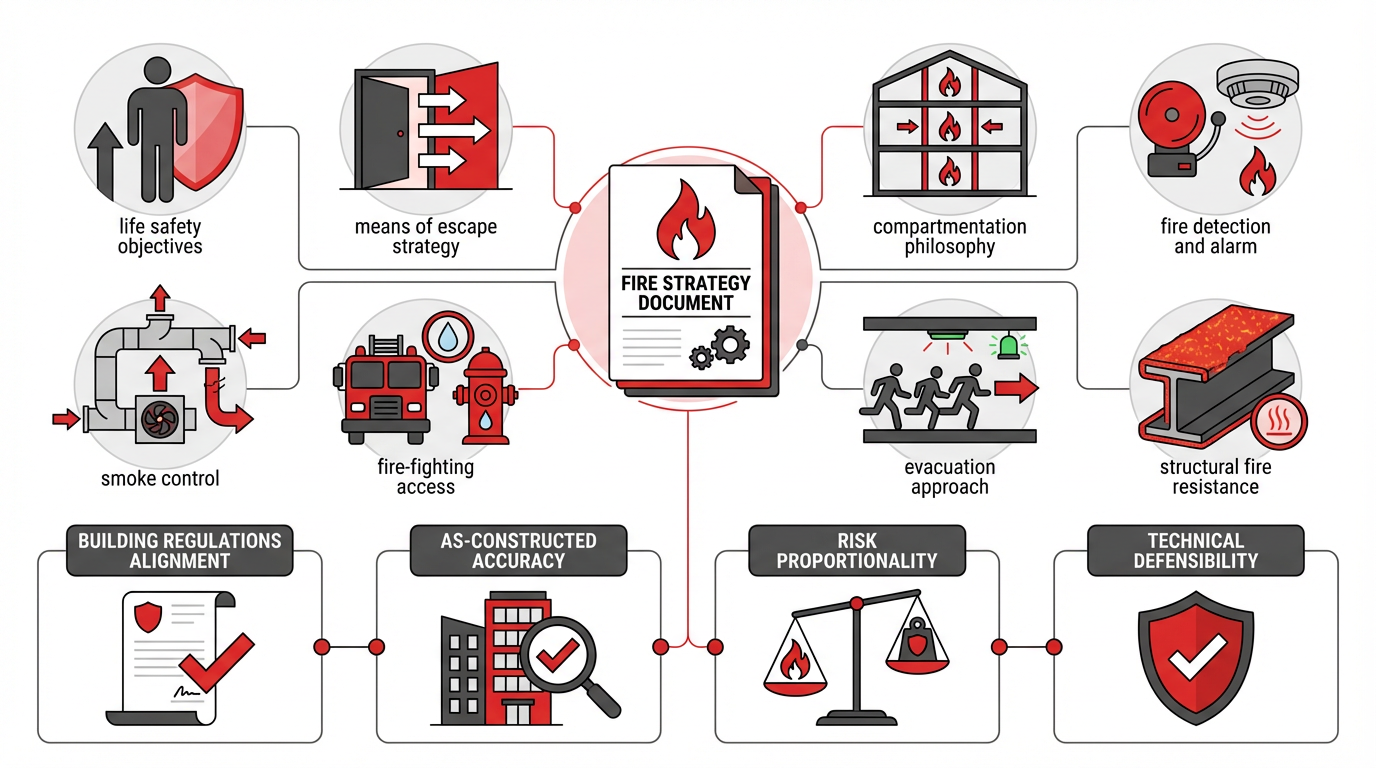
Fire Strategy Review & Validation provides structured, independent evaluation of:
- Life safety objectives
- Means of escape strategy
- Compartmentation philosophy
- Fire detection and alarm strategy
- Smoke control assumptions
- Fire-fighting access and facilities
- Evacuation approach
- Structural fire resistance strategy
The objective is to confirm that the strategy:
- Aligns with Building Regulations and recognised guidance
- Reflects the building as constructed
- Remains proportionate to current risk profile
- Is internally consistent and technically defensible
When Is Fire Strategy Review Required?
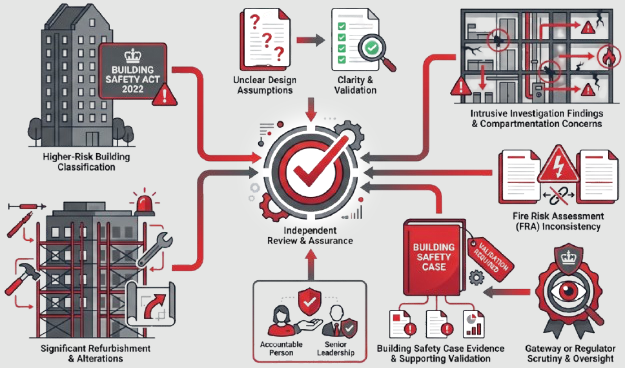
Fire Strategy Review & Validation is commonly required where:
- A building is classified as Higher-Risk under the Building Safety Act 2022
- Significant refurbishment or material alterations have occurred
- Design assumptions are unclear, undocumented or outdated
- Intrusive investigation findings challenge original compartmentation assumptions
- There is inconsistency between Fire Risk Assessment findings and design intent
- A Building Safety Case requires stronger evidence of design rationale
- Gateway or regulator scrutiny is anticipated
For Accountable Persons and senior leadership teams, independent validation provides additional assurance that fire strategy assumptions remain proportionate, defensible and aligned with current regulatory expectations.
This service is particularly relevant where the fire strategy exists but requires structured validation.
Independent Validation, Not Redesign
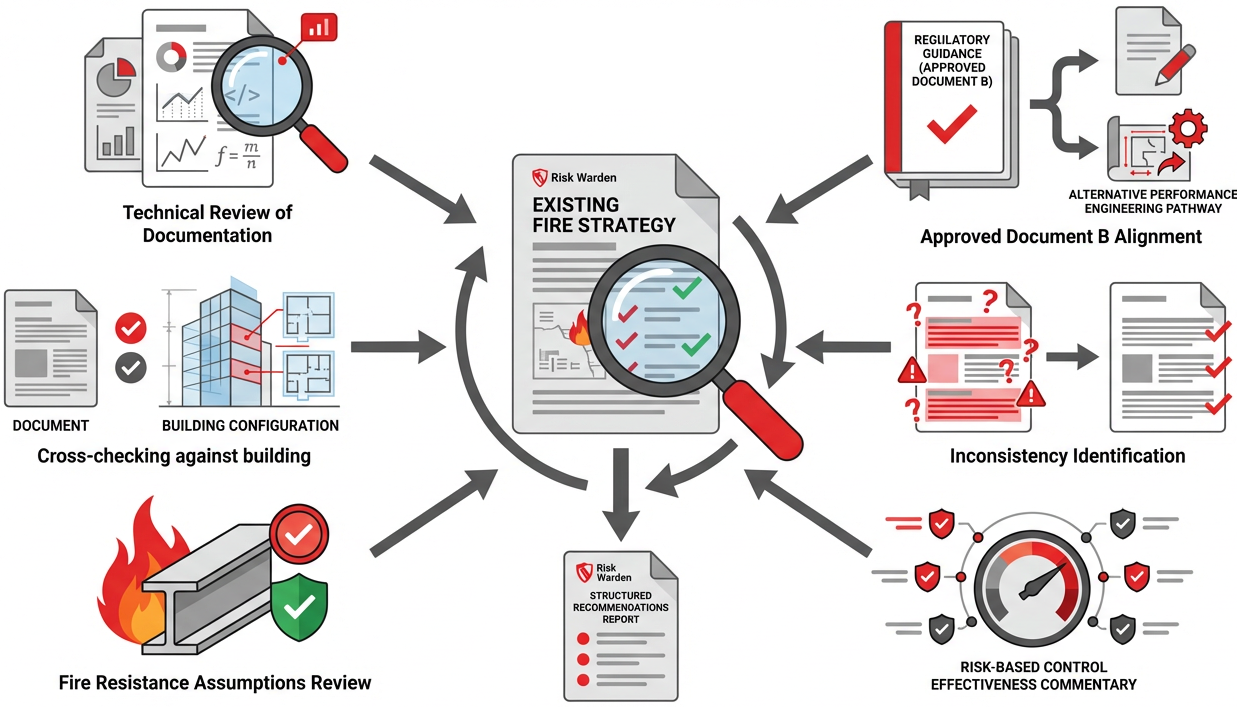
Fire Strategy Review & Validation is not a redesign service. It provides structured, independent scrutiny of the existing strategy and its implementation.
It involves:
- Technical review of existing strategy documentation
- Cross-checking against building configuration
- Review of fire resistance assumptions
- Verification of alignment with Approved Document B principles (or performance-based fire engineering justification where applicable)
- Identification of inconsistencies or areas requiring clarification
- Risk-based commentary on control effectiveness
Where material deficiencies are identified, structured recommendations are provided.
Integration With Building Safety Governance
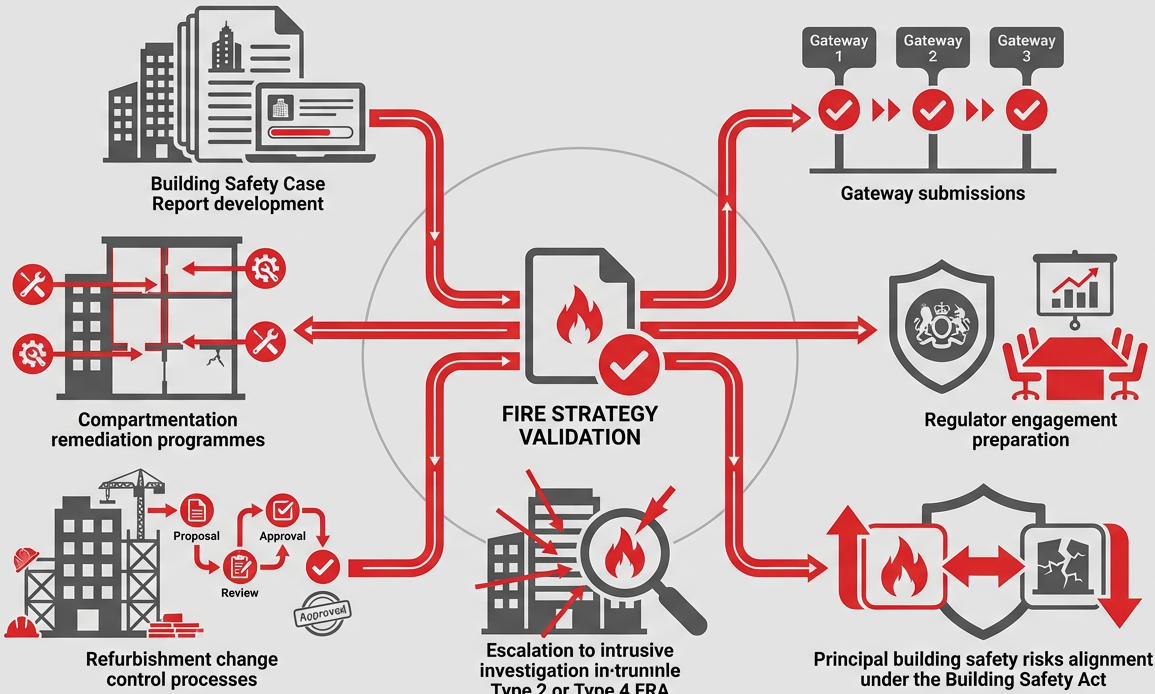
Fire strategy validation often forms part of broader regulatory assurance.
Outputs may inform:
- Building Safety Case Report development
- Compartmentation remediation programmes
- Escalation to intrusive investigation (Type 2 or Type 4 FRA)
- Refurbishment change control processes
- Gateway submissions
- Regulator engagement preparation
- Alignment with principal building safety risks under the Building Safety Act
This ensures fire strategy intent is clearly aligned with operational risk management and evidence governance.
Structured Review Methodology
Our review process typically includes:
1. Documentation Review
- Original fire strategy reports
- Design drawings and specifications
- Fire engineering calculations (where applicable)
- As-built information
2. Site Verification (where required)
- Inspection of key strategy-dependent elements
- Compartmentation logic checks
- Means of escape configuration validation
3. Technical Analysis
- Internal consistency review
- Proportionality assessment
- Risk exposure commentary
4. Validation Report
- Structured summary of findings
- Identified gaps or inconsistencies
- Clear recommendations
- Alignment commentary against regulatory expectations

Fire-Led, Risk-Proportionate Review
Fire Strategy Review is delivered through:
- Competent fire safety professionals
- Senior Technical Lead oversight for complex or higher-risk buildings
- Defined competence frameworks
- Structured technical validation controls
- ISO 9001-aligned governance
This ensures review outputs are proportionate, defensible and regulator-aware.
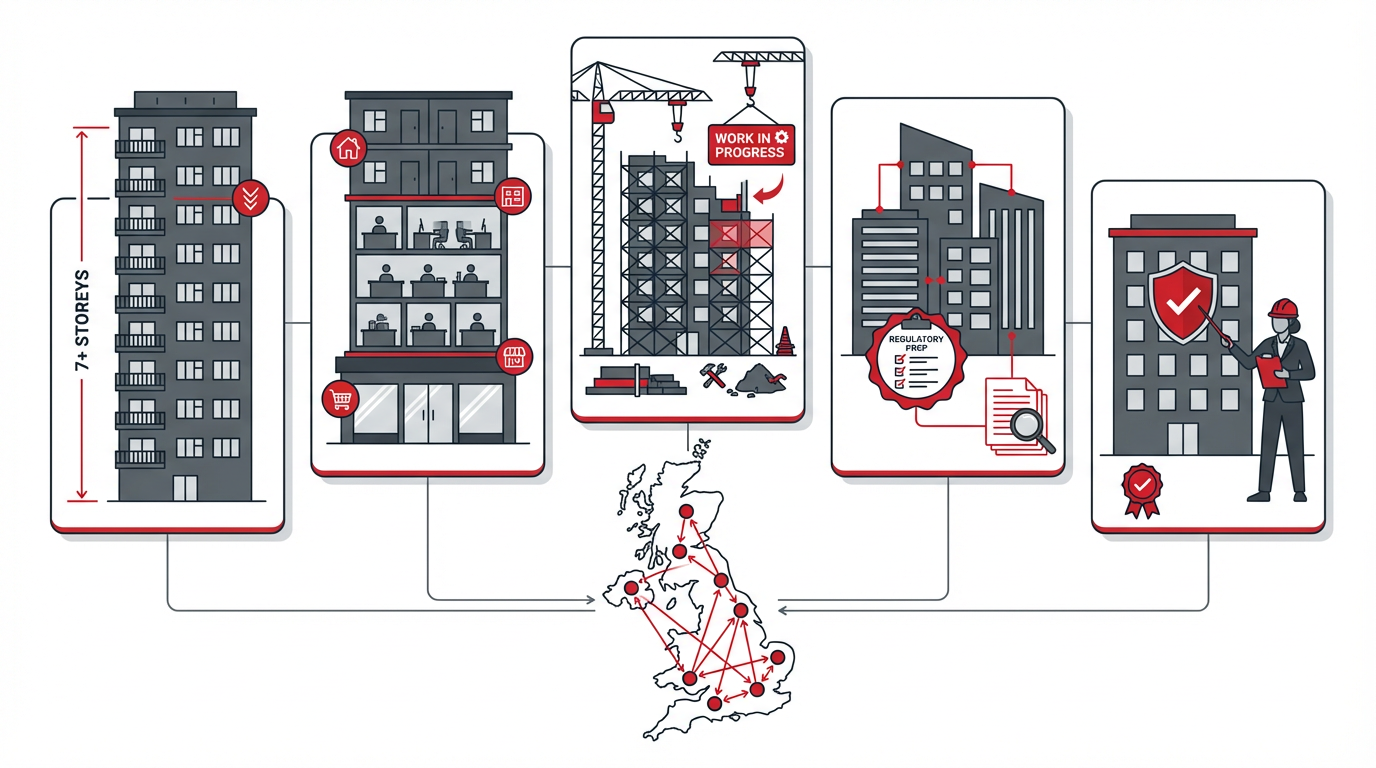
Designed for Complex & Higher-Risk Buildings
This service is particularly suited to:
- Residential Higher-Risk Buildings
- Complex mixed-use developments
- Buildings undergoing significant alteration
- Portfolios preparing for regulator engagement
- Organisations requiring independent technical assurance
National capability supports consistent delivery across multi-region estates.
Why Risk Warden?
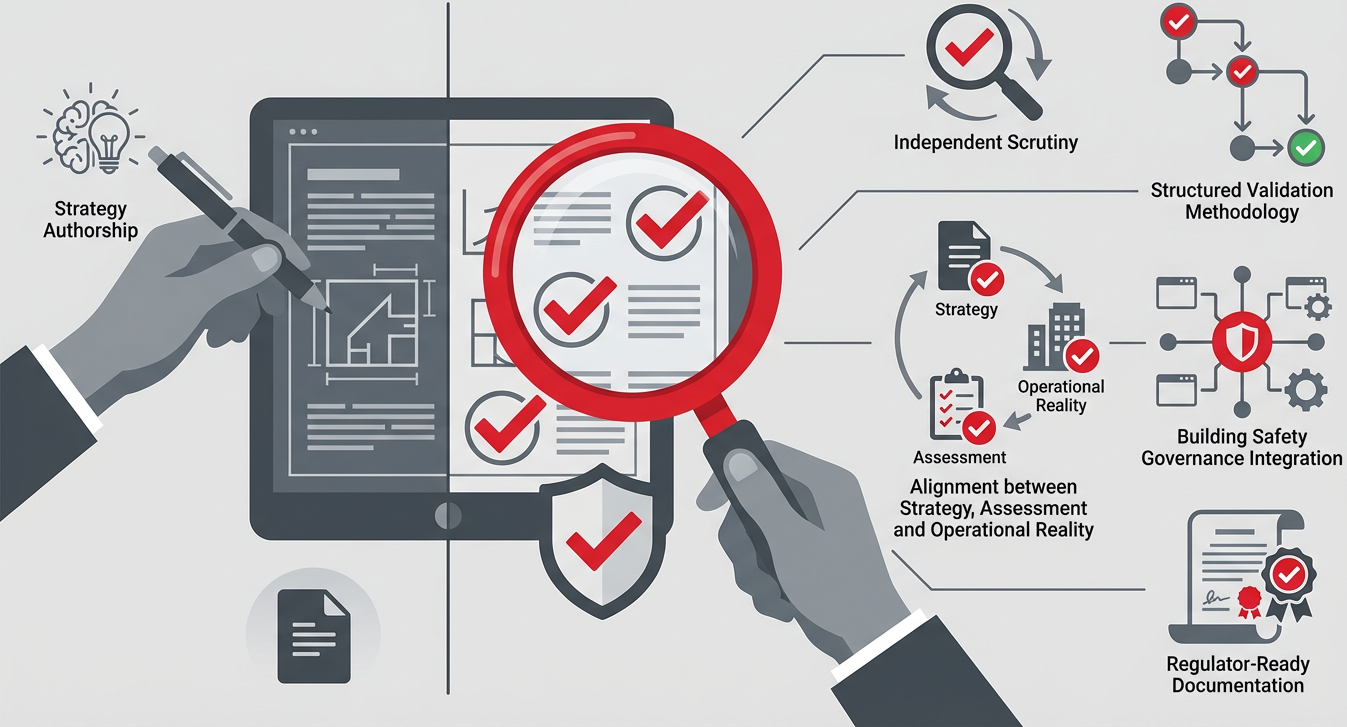
Risk Warden provides independent review and validation separating strategy authorship from technical assurance and governance oversight.
We deliver:
- Independent scrutiny
- Structured validation methodology
- Integration with Building Safety governance
- Alignment between strategy, assessment and operational reality
- Regulator-ready documentation
Fire strategy validation becomes part of structured building safety governance, not a standalone technical opinion.
Strengthen Confidence in Your Fire Strategy
Fire strategy assumptions must remain clear, proportionate and defensible, particularly in Higher-Risk Buildings.
Risk Warden provides structured Fire Strategy Review & Validation designed to support regulatory confidence and accountable governance.
Frequently Asked Questions
Fire Strategy Review & Validation
No. However, it is strongly recommended for Higher-Risk Buildings, complex developments and buildings undergoing significant change.
No. A Fire Risk Assessment evaluates live fire risk and management controls. Fire Strategy Review validates the underlying design intent and structural fire safety assumptions. The two are complementary.
Yes. Where strategies are historic or incomplete, we can review and validate available documentation and identify gaps requiring clarification.
Where inconsistencies or risk exposure is identified, structured commentary and recommendations are provided. Intrusive investigation may be recommended where proportionate.
Yes. Structured validation can strengthen documentation and technical defensibility in anticipation of regulator engagement.

Most providers offer either software or assessments. We deliver both — under one governed framework. This removes fragmentation, duplication and compliance blind spots.
Unlike traditional software vendors or isolated consultants, Risk Warden operates as a single, accountable compliance partner.

Useful Links
© Copyright 2025 Risk Warden Limited