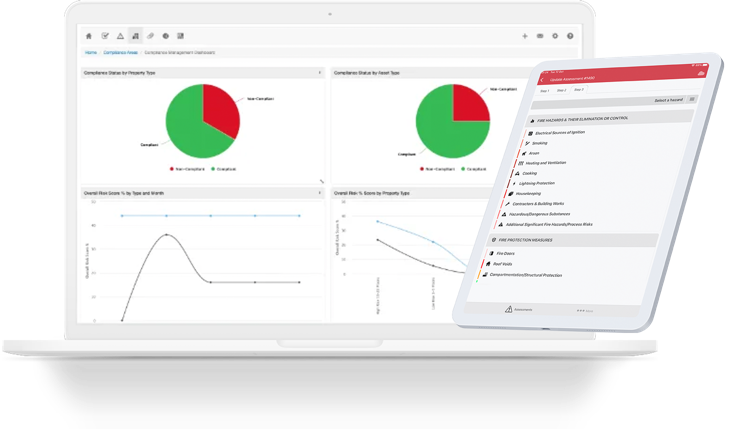
Fire Risk Assessments
Structured fire risk assessments for regulated residential, commercial and mixed-use buildings.
Request a Fire Risk AssessmentWhat Is a Fire Risk Assessment?
A Fire Risk Assessment (FRA) is a structured evaluation of fire hazards, risk controls and life safety arrangements within a building.
It identifies:
- Fire hazards
- People at risk
- Existing control measures
- Required remedial actions
- Ongoing management responsibilities
Fire Risk Assessments form the foundation of compliant fire safety management across residential, commercial and public-sector buildings.
Structured Fire Risk Assessment Delivery
Risk Warden delivers Fire Risk Assessments aligned to UK fire safety legislation and Building Safety Act expectations.
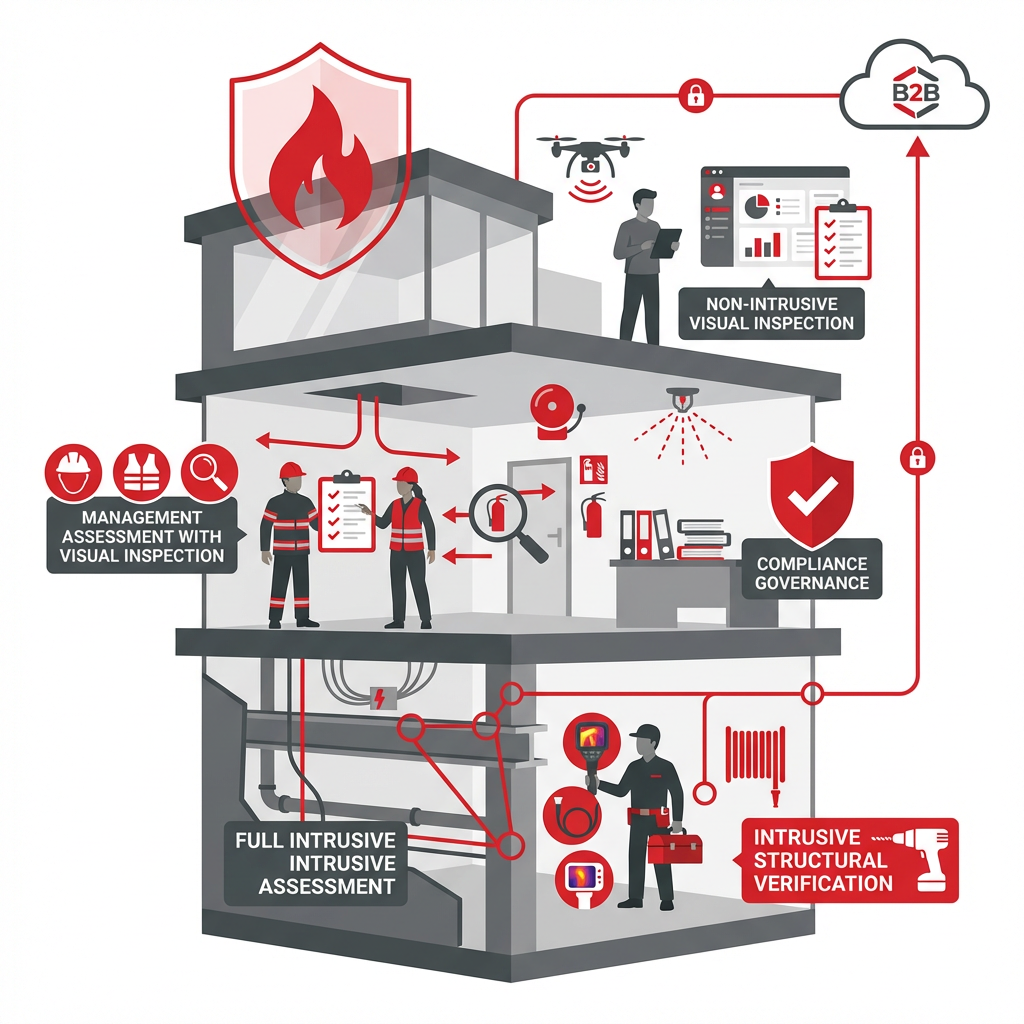
From non-intrusive management assessments to full intrusive structural verification, assessments are delivered through a defined mobilisation framework and governed within the Compliance Operating System.
Types of Fire Risk Assessment
The appropriate assessment type depends on building complexity, risk profile and construction certainty.
Fire Risk Assessment
Type 1
Non-intrusive assessment of common areas and management arrangements.
Suitable where building construction is understood and no intrusive investigation is required.
Fire Risk Assessment
Type 2 – Intrusive
Targeted intrusive assessment to investigate specific areas of concern.
Suitable where construction detail is uncertain or concealed risks require investigation.
Fire Risk Assessment
Type 4 – Destructive
Full intrusive structural assessment to verify fire-resisting construction and compartmentation integrity.
Typically required in higher-risk or complex buildings where construction detail cannot be confirmed.
Risk-Scored Findings & Structured Remediation
All Fire Risk Assessments delivered by Risk Warden include:
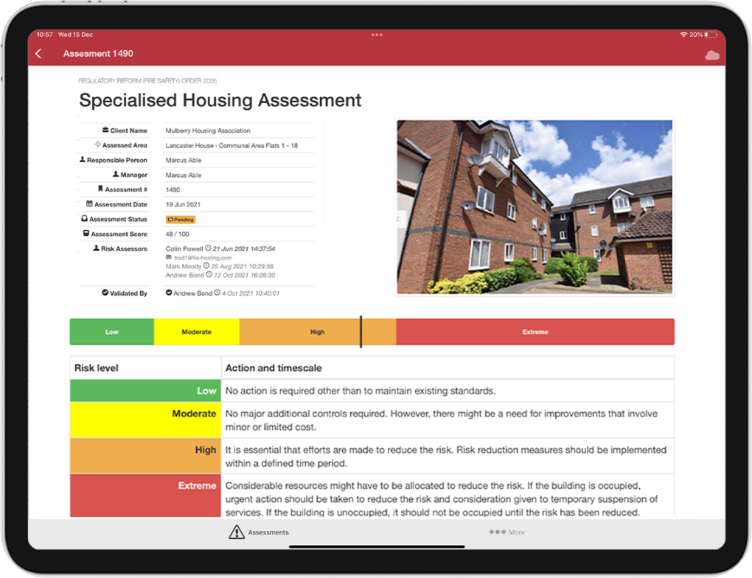
- Likelihood and consequence risk scoring
- Defined and consistent risk matrix methodology
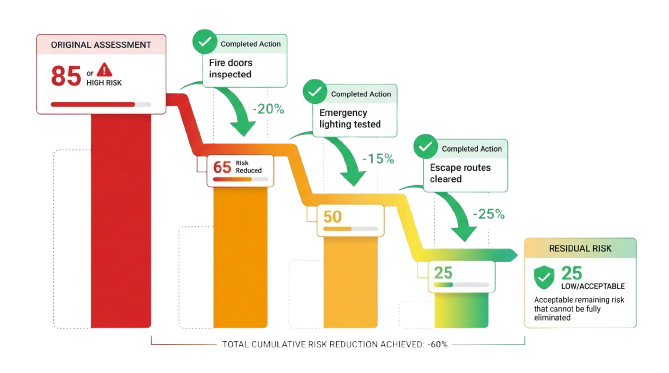
- Assessor-defined risk reduction percentage
- Automatic recalculation of reduced risk upon validated action completion
- Retention of original and reduced risk scores for audit
Remedial actions are assigned priority and governed within a structured remediation framework, ensuring risk progression is measurable and defensible.
Delivered Within the Compliance Operating System
Fire Risk Assessments are not static PDF documents.
Where delivered within the platform, assessments enable:
This ensures compliance is actively governed rather than periodically documented.
Experience, Competence & Delivery Assurance
Fire Risk Assessments are delivered through a defined mobilisation and delivery framework aligned to regulated property portfolios.
Our approach includes:
- Competent fire risk assessors
- Structured assessment methodology across all sites
- Defined technical and quality assurance review
- Consistent reporting standards
- Governance oversight within the platform
- Capacity to scale nationally while maintaining governance standards
Services remain proportionate to the building’s risk profile and regulatory expectations, while remaining defensible and scalable across multi-site estates.
When Is an Intrusive Assessment Required?
Intrusive assessments may be necessary where:
- Construction detail is uncertain
- Compartmentation integrity cannot be confirmed
- Significant alterations have occurred
- Higher-risk buildings require enhanced verification
In such cases, a Type 2 or Type 4 assessment may be proportionate.

Integration with Wider Compliance & Operational Governance
Where findings indicate structural deficiencies or systemic management issues, Fire Risk Assessments may inform:
- Fire Compartmentation Surveys
- Fire Design Strategy review
- Retrospective Fire Design Strategy development
- Building Safety Case documentation
This ensures fire safety governance is aligned with broader building safety obligations.
Book a Fire Risk Assessment
Fire safety compliance begins with structured assessment — and continues through controlled remediation and governance.
Risk Warden delivers Fire Risk Assessments designed for modern regulatory scrutiny and multi-site estate management.
Frequently Asked Questions
Fire Risk Assessment
Yes. Fire Risk Assessments are required under UK fire safety legislation for most non-domestic premises and the common areas of residential buildings. Responsible Persons must ensure a suitable and sufficient assessment is carried out and kept under review.
The appropriate assessment type depends on building complexity, construction certainty and risk profile.
- Type 1 assessments are non-intrusive.
- Type 2 assessments include targeted intrusive investigation.
- Type 4 assessments involve full intrusive structural verification.
Assessment scope should be proportionate to building risk and regulatory expectations.
Fire Risk Assessments should be reviewed regularly and whenever significant changes occur to the building, occupancy or management arrangements. Higher-risk buildings may require more frequent review.
Not always. Type 1 assessments are non-intrusive. Intrusive inspection is introduced in Type 2 and Type 4 assessments where construction detail or compartmentation integrity requires verification.
No. A Fire Risk Assessment evaluates overall fire safety management and risk. A Fire Compartmentation Survey verifies the physical integrity of passive fire protection elements. The two are complementary and may inform one another.

Most providers offer either software or assessments. We deliver both — under one governed framework. This removes fragmentation, duplication and compliance blind spots.
Unlike traditional software vendors or isolated consultants, Risk Warden operates as a single, accountable compliance partner.

Useful Links
© Copyright 2025 Risk Warden Limited