Legionella Risk Assessments
Structured legionella risk assessments for regulated residential, commercial and public-sector buildings.
Request a Legionella Risk AssessmentStructured Legionella Risk Assessment Delivery
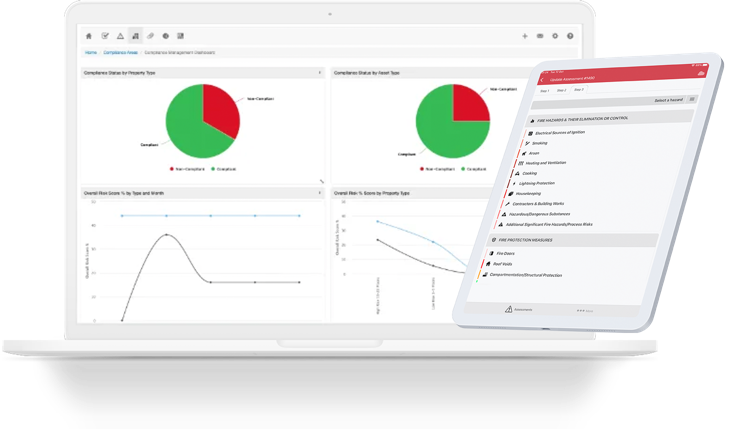
Risk Warden delivers Legionella Risk Assessments aligned to UK health and safety legislation, ACOP L8 and HSG274 guidance.
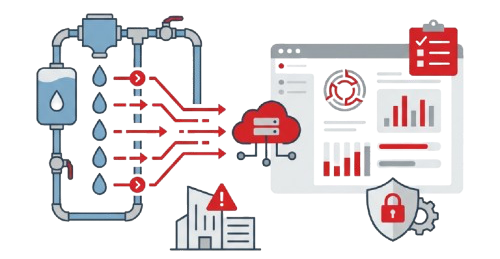
Assessments are delivered through a defined mobilisation framework and governed within the Compliance Operating System, ensuring water hygiene risks are identified, prioritised and governed through structured remediation.
Risk-Scored Findings & Structured Remediation
All Legionella Risk Assessments delivered by Risk Warden include:
- Likelihood and consequence risk scoring
- Defined and consistent risk matrix methodology
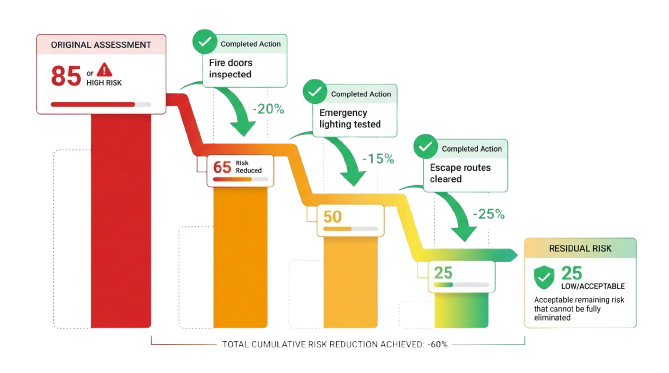
- Assessor-defined risk reduction percentage
- Automatic recalculation of reduced risk upon validated action completion
- Retention of original and reduced risk scores for audit
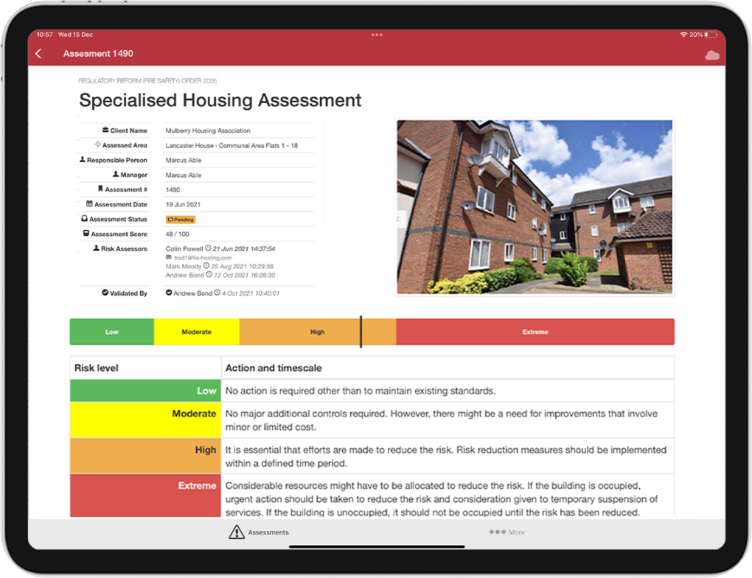
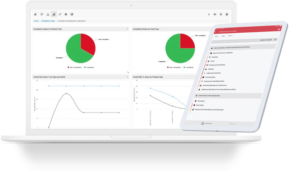
Risk scoring remains live within the platform, enabling ongoing visibility of current and reduced risk positions.
Remedial actions are assigned priority and governed within a structured remediation framework, ensuring water hygiene risks are measurable and defensible.
Delivered Within the Compliance Operating System
Legionella Risk Assessments are not static reports.
Where delivered within the platform, assessments enable:
This supports active compliance with statutory water hygiene duties rather than periodic documentation alone.
Integration with Wider Property & Compliance Governance
Legionella risk management forms part of broader property and statutory compliance obligations.
Where required, findings may inform:
- Planned Preventative Maintenance (PPM) schedules
- Contractor performance oversight
- Incident and investigation workflows
- Portfolio-level compliance reporting
This ensures water hygiene governance is integrated with wider building safety and compliance management processes.
Experience, Competence & Delivery Assurance
Legionella Risk Assessments are delivered through a defined mobilisation and delivery framework aligned to regulated property portfolios.
Our approach includes:
- Competent water hygiene assessors
- Defined technical and quality assurance review
- Standardised methodology across all sites
- Consistent reporting standards
- Governance oversight within the platform
- Capacity to scale nationally while maintaining governance standards
Services remain proportionate to the building’s risk profile and statutory expectations, while remaining defensible and scalable across multi-site estates.
Broader Fire & Property Risk Coverage
Risk Warden supports wider fire, health and property risk programmes within the same compliance environment.
In addition to Legionella Risk Assessments, we deliver:
Beyond assessment delivery, Risk Warden supports organisations requiring asset management, contractor evaluation and estate-wide compliance oversight through expanded platform plans.
Where strategic advisory or formal regulatory documentation is required, Building Safety Strategy & Assurance and Consultancy services provide structured governance support.
Book a Legionella Risk Assessment
Water hygiene compliance requires structured assessment and controlled remediation.
Risk Warden delivers Legionella Risk Assessments designed for modern regulatory scrutiny and portfolio-wide governance.
Frequently Asked Questions
Legionella Risk Assessment
A Legionella Risk Assessment is a structured evaluation of a premises’ water systems to identify where legionella bacteria could grow, assess the risks to people, and determine appropriate control measures to prevent exposure. It supports ongoing water hygiene compliance under health and safety law.
A Legionella Risk Assessment is required wherever a building has water systems that could support legionella growth, for example, hot and cold water systems, tanks, showers and outlets. Assessments should also be reviewed periodically and whenever there is reason to believe the current assessment may no longer be valid, such as after changes to the water system or its use.
Yes. UK health and safety legislation requires duty holders to assess and control the risk of legionella in water systems. A suitable and sufficient assessment must be carried out and kept under review.
Legionella Risk Assessments should be reviewed regularly and whenever significant changes occur, such as modifications to water systems, changes in building use or occupancy, or following an incident. Higher-risk environments may require more frequent review.
Not necessarily. Sampling may be recommended where system conditions or risk factors indicate potential concern. The need for sampling is determined based on system design, risk profile and management controls.
Identified hazards are assessed using a structured likelihood and consequence framework. Remedial actions are assigned priority and governed through structured remediation tracking to ensure proportionate risk reduction.
Yes. Findings can inform Planned Preventative Maintenance schedules and contractor oversight, supporting ongoing water hygiene governance rather than one-off reporting.

Most providers offer either software or assessments. We deliver both — under one governed framework. This removes fragmentation, duplication and compliance blind spots.
Unlike traditional software vendors or isolated consultants, Risk Warden operates as a single, accountable compliance partner.
Useful Links
© Copyright 2025 Risk Warden Limited